

The Lighting Industry in the AI Era: Lighting Designers Will Split into Two Types
After working in the lighting industry for a long time, you'll inevitably notice a common problem:
Many projects do light up, and there are plenty of lights, but they aren't necessarily good.
Some projects have chaotic, glaring lights.
Some buildings look fine during the day but become tacky at night when lit up.
Some projects have beautiful renderings, but the actual result is completely different.
And some projects are lively when first completed, but after a year or two, broken lights, color discrepancies, and control chaos set in, and no one maintains them.
These problems often stem from insufficient communication and design in the early stages. Most conversations with clients focus on fixtures, wattage, color temperature, and price, rather than what the space will actually look like after lighting is applied.
I call this the "light environment." Many projects never clearly define the light environment from the start.
People are just solving "what lights to install," not "how this space should be used at night."
1. The Lighting Industry Used to Compete on Lights, Now It Competes on Professional Judgment
For many years, the lighting industry's competition was mostly about:
Who has the lowest price, the highest specs, the flashiest renderings, and the fastest proposal delivery.
But that logic is shifting.
Because lighting fixtures are becoming more mature, supply chains are more transparent, and AI can generate lighting renderings.
Simply producing a rendering is no longer as rare as before.
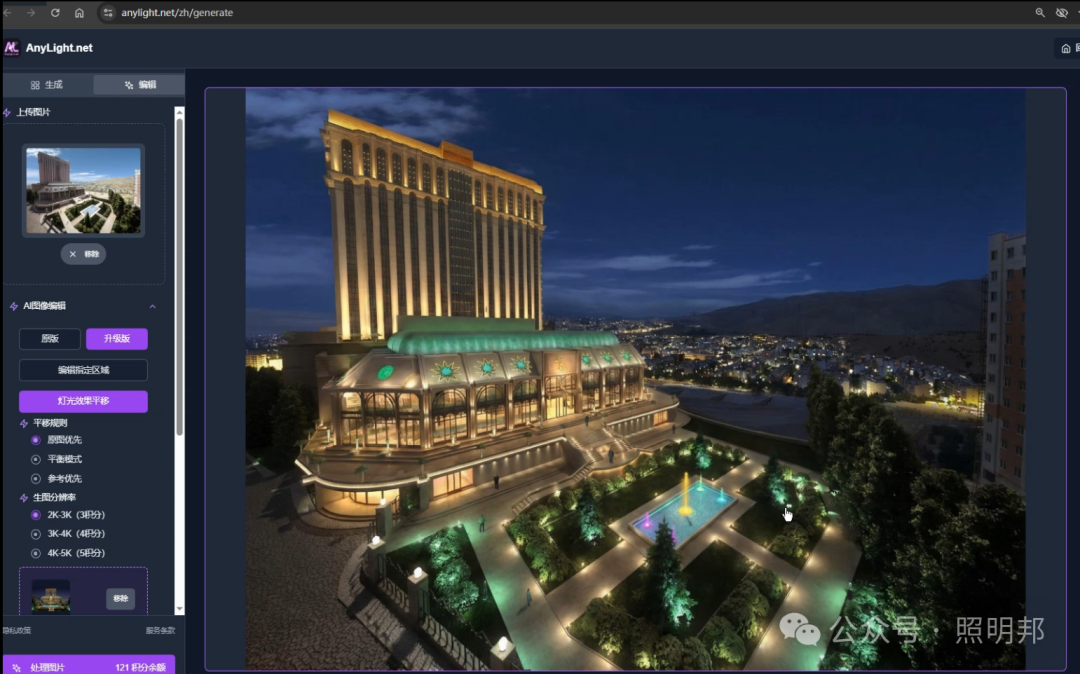
I later created the lighting rendering platform anylight.net because I saw this change:
AI will make lighting renderings cheaper, but the ability to judge direction will become increasingly important.
Previously, designing a lighting direction rendering might involve searching for references, Photoshop editing, adjusting lights, and repeatedly trying different lighting combinations.
Now, with AI, you can quickly generate different lighting directions for a building.
For example, for the same building, you can try:
Warm commercial atmosphere, festive lighting, simple contour lighting, or even a cultural tourism night tour feel.
The value of this is not to have AI directly replace designers. Instead, it's to first present "possible directions."
Let clients, designers, and salespeople see first: which direction this project might suit.
Which direction looks comfortable.
Which direction looks good but might be too expensive.
Which direction is suitable for promotion but not for long-term operation.
At this point, the real value is no longer "whether you can produce renderings."
It's whether you can judge.
Can you judge whether this direction fits the project?
Can you judge whether this effect is feasible for implementation?
Can you judge whether the client truly wants image enhancement, commercial atmosphere, cultural tourism memory points, or just simple building decoration?
AI will make renderings cheaper, but it won't make judgment itself cheaper.

2. Light Environment Is Not a High-Tech Concept, but a Down-to-Earth Project Mindset
Some people hear "light environment" and think it's a big concept.
They feel it must involve healthy lighting, circadian lighting, smart controls, and city-level systems to qualify as a light environment.
I think there's no need to start so big.
For most lighting projects, the light environment can begin with a few simple questions:
Is this place safe at night?
Does it feel comfortable to walk into?
Does the building look more upscale when lit?
Does the cultural tourism project have memorable features?
Will the lighting affect nearby residents?
Is maintenance convenient later?
These questions aren't mystical.
But they are closer to the criteria for judging a good project than "how many watts, how many lights, how much money."
For example, a scenic area night tour project: the client isn't just buying lights; they want tourists to stay at night.
A sales center: the client isn't just buying lights; they want a quality, trustworthy look at night.
An urban road node: the client isn't just buying lights; they want safety, recognition, and city image.
A commercial complex: the client isn't just buying lights; they want foot traffic, dwell time, photos, and consumption atmosphere.
All these things together form the light environment.
3. What's the Gap Between "Selling Lights" and "Creating a Light Environment"?
I think there are three main differences.
First, scene understanding.
Even for lighting, different projects have different purposes.
Residential, hotels, commercial streets, bridges, scenic areas, office buildings—you can't use a one-size-fits-all approach.
Without understanding the scene, focusing only on fixtures and renderings often results in superficial flashiness.
Second, scheme judgment.
There's no shortage of renderings now.
AI can generate many, and designers can produce many.
But with more renderings, judgment becomes even more critical.
Which rendering is just flashy?
Which one is truly suitable for implementation?
Which one has too high a cost?
Which one will be troublesome to maintain later?
Which one is good for initial client communication?
These judgments rely on industry experience.
Third, long-term operation thinking.
Many lighting project problems don't appear right after completion.
They emerge gradually over one or two years.
Lights break and no one repairs them.
Control systems are too complex to use.
Brightness is too high and draws complaints.
The effect becomes outdated and no one updates it.
If you only approach it as "selling lights" from the start, these issues are basically ignored.
But if you think in terms of "light environment," you'll consider maintenance, control modes, and long-term use in advance.
4. Where Do AI Tools Fit?
I never think AI lighting rendering tools can solve all problems.
They can't solve construction quality, fixture quality, on-site installation, or replace complete construction drawings.
But they are very good at solving one early-stage problem:
Quickly judging direction.
In the initial communication of many projects, everyone's ideas are vague.
The client says they want something "high-end."
The salesperson says they need to show results.
The designer says they need to set a style first.
But what does "high-end" actually look like?
If you rely only on words, it's easy to communicate for a long time without clarity.
At this point, using tools like Anylight to generate a few directional renderings is very valuable.
Not to have the client immediately decide on the final plan.
But to turn abstract feelings into discussable visuals.
The tool quickly presents possibilities; the person judges which one suits the project better.
5. In the Future, the Lighting Design Industry May Split into Two Types of People
One type continues to just sell lights.
When a client asks about lights, they quote lights.
When a client wants low prices, they keep cutting prices.
When a client wants renderings, they quickly produce a bright-looking one.
This approach isn't completely unworkable.
There will always be a market for low prices.
But the problem is, this path will become increasingly competitive.
The other type starts moving toward the light environment.
They still understand lights.
But they don't just talk about lights.
They talk about scenes.
They talk about human experience.
They talk about commercial value.
They talk about maintenance.
They talk about lighting states at different times.
They talk about why this project shouldn't just pursue brightness.
These people may not make more money immediately.
But their value will be harder to simply replace.
Because fixture specs can be copied.
Renderings can be imitated.
But a complete judgment of a project is not easily replicated.
Of course, emphasizing the light environment doesn't mean denying the importance of fixtures themselves.
Many problems in the industry today stem from poor fundamentals: low-price competition, inflated specs, unstable quality, and gaps between renderings and actual results.
If these issues aren't resolved, talking about smart lighting, healthy lighting, and light environments will remain empty words.
So the real upgrade isn't about using fancier terms; it's about first making good lights, then making good light.
I now prefer to understand the lighting industry this way:
Lights are products.
The light environment is the result.
Renderings are communication tools.
AI is a tool to improve early-stage judgment efficiency.
What lighting designers and engineering companies truly need to do is turn the client's vague needs into a light environment that can be judged, communicated, implemented, and maintained.
What's truly scarce now is not one more rendering. It's whether you can understand the light environment behind that rendering.
Need night lighting effect images fast?
Use Anylight to turn your daytime photos into professional night lighting visuals for architectural lighting, landscape lighting, cultural tourism lighting, and more.