

A $4 Lighting Rendering Reveals a Folded, Surreal World
Yesterday, a fellow lighting designer added me as a friend and asked how to use Anylight.
I was puzzled—there are free video tutorials on the website's homepage. Why not check those first?
He replied "OK" and then sent me a few lighting renderings, asking if Anylight could produce that kind of effect.
I opened them and saw very amateur work. From my perspective, they were not up to par.
I asked if he made them himself, if he worked at a lighting factory or an engineering company.
He said he used to work at a lighting factory but now runs his own business, and these were renderings he made for clients.
So I asked, how much do you charge for one?
He said, some are $4, some are $7.
I paused for a moment—not because it was absurd, but because I remembered an article I read about Beijing being divided into three physical spaces, where different classes live in different worlds, as if folded.
They share the same sky and the same time, yet rarely truly see or understand each other. They live in the same city, but their life experiences, ways of understanding, and destinies are as distant as another world.
This is exactly like the lighting designer community. Some charge only $4–$7 per rendering, some charge $15–$30, others $40–$100, and some even charge hundreds or thousands for a single rendering.
We're all in the same industry, all doing lighting design, but lighting designers are folded into different spaces.
So what causes this difference? After careful thought, I believe there are three fundamental reasons.
1. Information Gap
Just look at the tools.
Many designers still use old methods for lighting renderings—painstakingly using Photoshop to cut out images, retouch, and add lighting. They've heard of AI but never actually applied it.
Some designers have started using tools like Doubao or Jimeng to generate night scene atmospheres, then combine them with Photoshop to add lighting. This is much more efficient.
But the lighting effects produced by these AI tools for actual lighting projects are often unsatisfactory, especially for larger scenes. Details become blurry and distorted, and lighting exposure is uncontrollable. If the client has slightly higher requirements, the renderings usually fail.
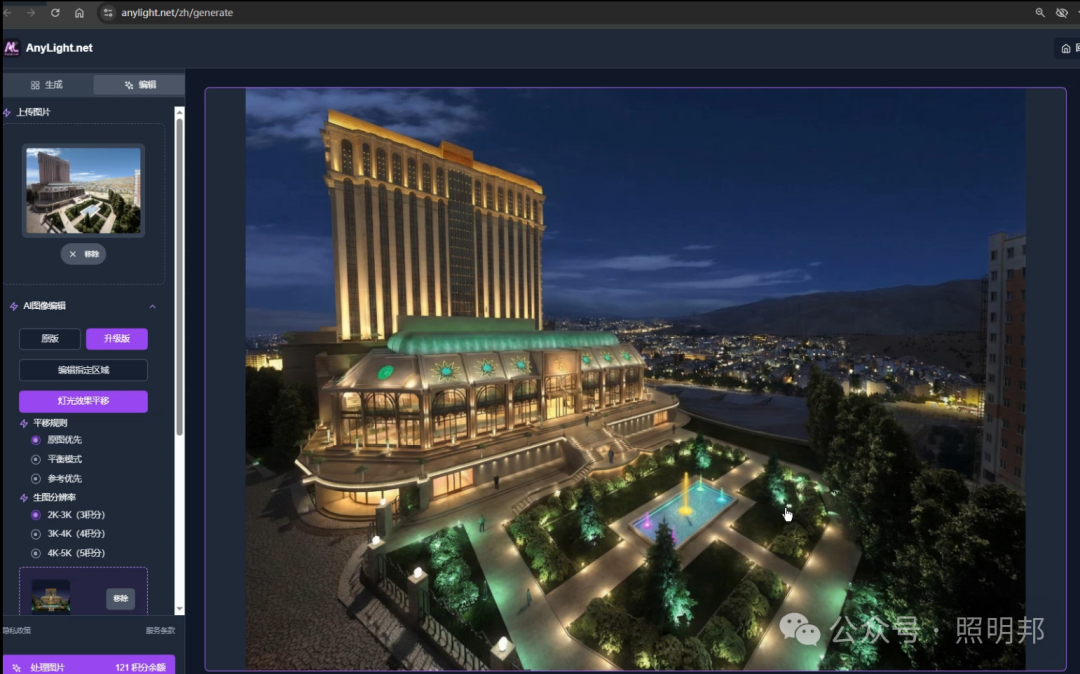
Meanwhile, another group of designers has already mastered professional lighting design platforms like Anylight.net. They can produce basic effects in minutes, and spend more time on how to design lighting that truly fits the project, rather than on retouching images.
The fold in the information gap is right here: some don't know, still using old methods; some know but haven't accessed advanced tools; and some have already mastered advanced tools.
I remember when I started researching AI for lighting renderings two years ago, many people commented on my social media that no matter how good AI is, it can't produce lighting effects.
Later, as AI improved, people said AI lighting effects are uncontrollable and still require manual work.
In the first half of last year, people said AI can't handle large scenes and isn't useful.
Now, I haven't seen such comments in a long time.
2. Experience Gap
The information gap isn't the most critical; the experience gap is.
Some designers simply add lights to a building. The client gives them a photo of a building, and they just make it glow.
They outline the contours with linear lights, illuminate the facade with floodlights, emphasize the entrance—and the rendering shows lighting, task done.
Some designers are more skilled. They know the effect needs to be aesthetically pleasing and harmonious.
Commercial streets should be lively, office buildings should be stable, hotels should be upscale. They consider hierarchy, avoid garishness, and unify color temperatures.
But there are also designers who not only see the effect in the rendering but also consider issues beyond the image.
They see whether the project is viable, what the client believes in, where the lights are hidden, whether the facade can support them, whether the installation is feasible, whether problems will arise later, whether surrounding areas will suffer from glare or light pollution, and so on.
The experience gap is reflected not only in how good the rendering looks, but more importantly, in whether there is judgment behind the image and whether the implementation is reliable.
3. Client Gap
Clients are also stratified.
Some clients don't understand and have low expectations. As long as the image turns day into night with lights and atmosphere, they're satisfied.
For such clients, talking too much about fixtures, installation, control, and maintenance may not interest them.
Some clients ask more detailed questions: What kind of light goes here? Wall washer or linear light? Can the actual installation match the rendering? These clients start to care about the relationship between the rendering and the project.
Higher-level clients don't just look at the lights themselves.
They consider whether the effect matches the project's character, whether it affects the daytime facade, whether maintenance costs are high, whether they can justify the design in presentations, and whether there is a design concept.
These clients aren't buying a single image.
They are buying the designer's professional judgment, peace of mind, avoiding pitfalls, and the trust that saves their time and energy.
So a $4 lighting rendering doesn't just show me a low price—it reveals the many folded worlds within the lighting industry.
Whether it's the information gap, experience gap, or client gap, when you see this folded, surreal world, you might reconsider one question:
What am I really charging for? And how can I charge more?
Need night lighting effect images fast?
Use Anylight to turn your daytime photos into professional night lighting visuals for architectural lighting, landscape lighting, cultural tourism lighting, and more.