

Don't Just Be a Cog in the Machine: In the AI Era, Operate Like a Company
The concept of "OPC" (One Person Company) is gaining traction. After learning about it, I find it quite similar to the "Q-shaped talent" concept I've been advocating.
OPC: The "One Person Company" entrepreneurial model in the AI era—a new organizational form where an individual leverages AI to independently complete a business loop.
In simple terms, it means one person can operate like a company.
It doesn't mean you have to personally handle everything—boss, sales, customer service, design, operations, finance—that's unrealistic.
My understanding of a One Person Company is more like a person standing at the center, using AI, tools, content, and a few external resources to get things running.
This is essentially the Q-shaped talent I've always talked about, but now with AI, it's easier to achieve.
Q-shaped talent: The dot on top of the Q represents your strengths, expertise, and professional skills. The circle around the Q represents a system, a capability loop.
For example, you can create lighting renderings, animations, write articles, or make products—these are all your "dots."
But having just the dot isn't enough.
The circle outside the Q is what truly determines whether you can earn independently.
What does this circle include?
Where do customers come from? Why do people trust you? What do you sell? How do you close deals? How do you deliver? How do you make people remember you?
Previously, many people only focused on the dot.
For instance, lighting designers thought that as long as they made good renderings and animations, they'd always have work.
A few years ago, when the industry was booming, this mindset wasn't a big problem.
Projects were plentiful, companies were hiring, and bosses needed designers. As long as your skills were decent, you could find a position.
But now it's different.
The industry isn't as hot as before. Fewer projects, more competition, and AI tools have emerged.
Previously, a professional lighting rendering might take a design company a whole day to assign to you.
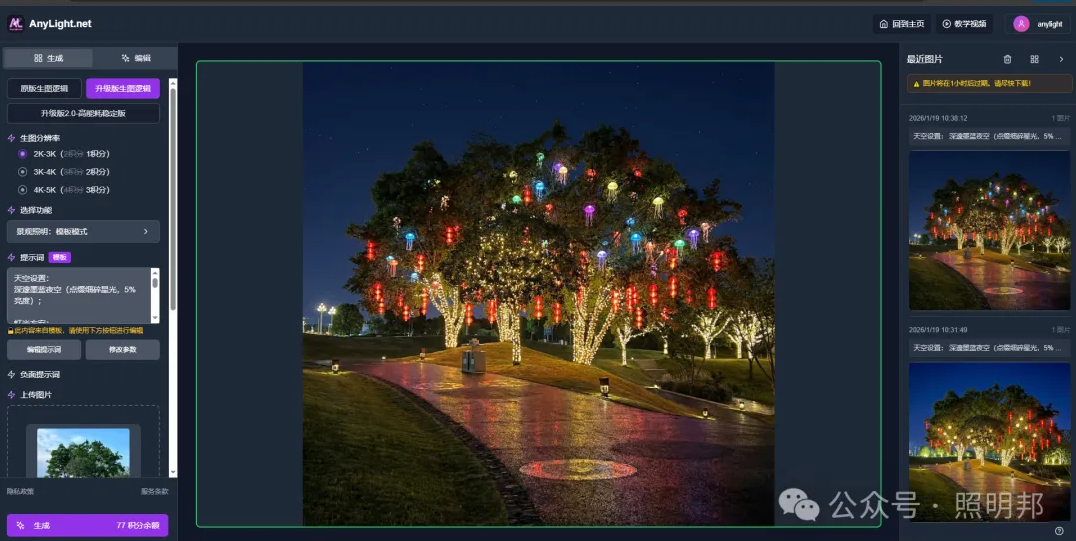
Now, with platforms like Anylight.net specifically for generating lighting renderings, you can easily produce three to five, or even seven or eight, in a day.
Skills that used to take a designer years to develop can now be mimicked by a novice using AI to produce a decent-looking plan.
This doesn't mean technical skills are useless—they definitely are.
But if you only have technical skills, and clients don't know you or trust you, and you don't know how to quote, collect payment, or continuously acquire new clients, then you're still dependent on someone else's system.
When the company has projects, you have work.
When the company doesn't, you're passive.
The real change in the AI era is that it has lowered the barrier for what used to be "professional work."
Professional skills are no longer as scarce as before, so they're less competitive.
Since everyone can do it, where does the difference lie?
The difference is no longer in "whether you can do it," but in "what you should do."
This question is actually harder.
Making a lighting rendering is easy; the hard part is finding clients.
Making a product is easy; the hard part is judging whether anyone actually needs it.
Making a tool is easy; the hard part is knowing if users are willing to pay.
That's the value of the circle on the Q.
When I talked about Q-shaped talent before, I wanted to remind lighting designers not to just focus on renderings, but also understand clients, products, traffic, sales, and branding.
Now, this insight is even more important.
So I increasingly believe that a One Person Company isn't about one person struggling to do everything alone.
The ideal state for a One Person Company is you standing at the center.
You have a professional skill as a starting point.
Then you use AI to help with research, content creation, organizing information, optimizing processes, and handling customers.
You use products and tools to reduce communication.
You turn repetitive questions into documentation, repetitive processes into templates, and repetitive deliveries into products.
This way, a One Person Company isn't one person doing everything, nor one person becoming a versatile employee, but one person becoming the designer of a small system.
That's the true core of a One Person Company.
Previously, Q-shaped talent meant professional skills plus business skills.
In the AI era, Q-shaped talent means professional skills plus judgment skills, plus the ability to command AI and tools.
That dot is still your expertise.
That circle becomes whether you can use AI to connect clients, products, content, sales, and delivery.
In the future, those with real opportunities are those who have genuine professional expertise and are willing to productize, systematize, and tool it.
In short, don't just be a cog in someone else's machine.
And don't fantasize about going it alone.
What you need to do is first find your dot.
Then use AI to gradually build up the circle around it.
Need night lighting effect images fast?
Use Anylight to turn your daytime photos into professional night lighting visuals for architectural lighting, landscape lighting, cultural tourism lighting, and more.